Continuous security
for teams that ship daily.
BugThrive pairs elite manual hackers with continuous automated analysis — find and fix vulnerabilities at the speed your team ships, without pausing development for legacy pentests.
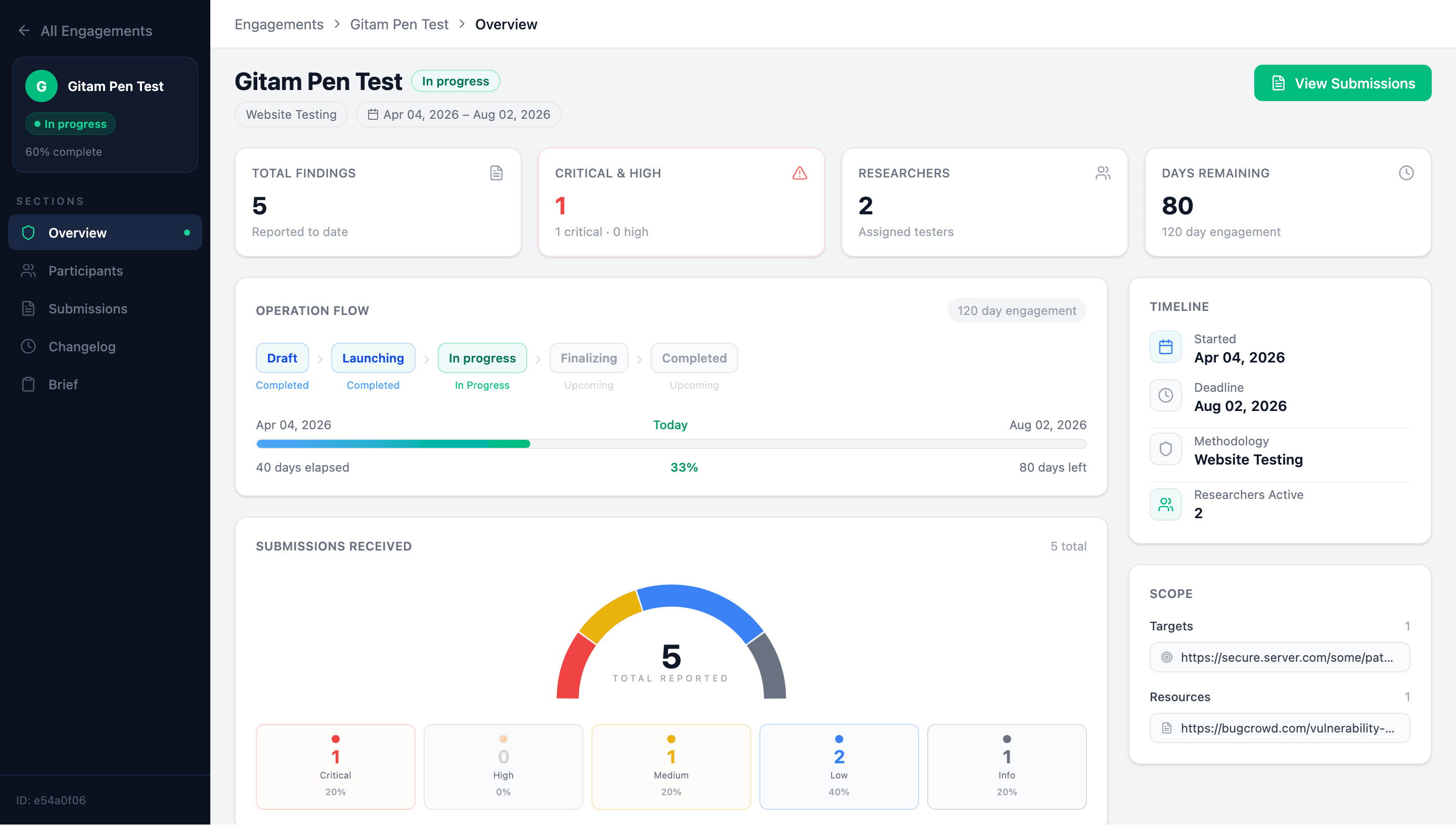
Meet Drigar — your AI pentest agent.
Drigar is BugThrive's purpose-built AI agent for offensive security work. He hunts continuously, reasons across your entire attack surface, and hands every candidate to a human tester for verification — no autonomous exploitation, no shadow data, no compromises.

Always-on hunting
Drigar probes your stack 24/7 — every new commit, every new endpoint, every config drift triggers a focused sweep.
Cross-surface reasoning
He correlates findings across web, API, cloud, and code — recognizing chained exploit paths a single-surface scanner cannot see.
Human-in-the-loop
Drigar proposes. A senior tester disposes. No autonomous exploitation, no severity calls without human confirmation.
In their own words.
“BugThrive found critical logic flaws in our billing API that automated scanners completely missed. The ROI was immediate.”
“Clean interface, real-time findings, and triage that saves my team hours every week. We've shipped faster since onboarding.”
“Gone are the days of reading 200-page pentest PDFs. The continuous model is exactly what modern teams need.”
“One-click retesting collapses fix verification from weeks to hours. My engineers don't hate security anymore.”
One platform for continuous security testing.
Discover assets in your stack, prioritize what matters, validate with manual exploitation, and remediate inside the tools your engineers already use.
Attack Surface Management
Continuously discover, inventory, and monitor your external attack surface with AI-driven asset discovery and risk scoring.
- › External asset discovery
- › Shadow IT detection
- › Risk scoring
Application Security Posture
Unified application security across your entire stack — from code to cloud — with contextual risk prioritization.
- › SDLC integration
- › Code-to-cloud visibility
- › AppSec orchestration
Risk-Based Vulnerability Management
Prioritize vulnerabilities by real business risk using exploit intelligence, asset context, and attack path analysis — not just CVSS.
- › Business risk scoring
- › Exploit intelligence
- › Noise elimination
AI-Assisted Pentesting
Drigar, our AI pentest agent, continuously validates your defenses at scale with adversarial proof of exploitability.
- › Autonomous hunting
- › Exploit validation
- › Continuous assessment
Penetration Testing as a Service
On-demand, expert-led penetration testing with real-time collaboration, continuous retesting, and full remediation support.
- › Expert-led testing
- › Real-time collaboration
- › Continuous retesting
CI / CD Security Gates
Gate releases on severity, run targeted scans on every PR, and sync verdicts back to your engineering workflow automatically.
- › PR-level scanning
- › Merge blocking on criticals
- › Status check posting
From visibility to execution
Security teams don't just struggle with visibility. They struggle with turning fragmented insight into action. Most tools deliver isolated views and generate tickets but stop short of helping teams understand what actually matters or what to do next.
A continuous loop — not a one-time engagement.
Traditional pentests are point-in-time. BugThrive runs as an always-on cycle: scope, discover, test, exploit, report, verify — then loop. Every cycle inherits context from the last.
Scope
Define assets, integrate stack
Discover
Map attack surface, fingerprint
Test
Automated + manual probing
Exploit
Build PoC, score impact
Report
Push fix guidance to owner
Verify
One-click retest, audit trail
Every signal flows through intelligence.
Raw findings from automated and manual sources are normalized, deduplicated, and ranked by an AI-assisted intelligence layer — so your team acts on signal, not noise.
12,400 signals in. 142 real findings out.
Raw security telemetry is mostly noise. We compress it through four ranked filters — dedup, AI scoring, human review, and business context — so engineers see only what actually needs a fix.
Built for certainty
with human control.
Automation surfaces candidates. People decide what ships. Every action — exploit attempt, severity bump, scope expansion — runs through approval, leaves an audit trail, and respects the kill switch.
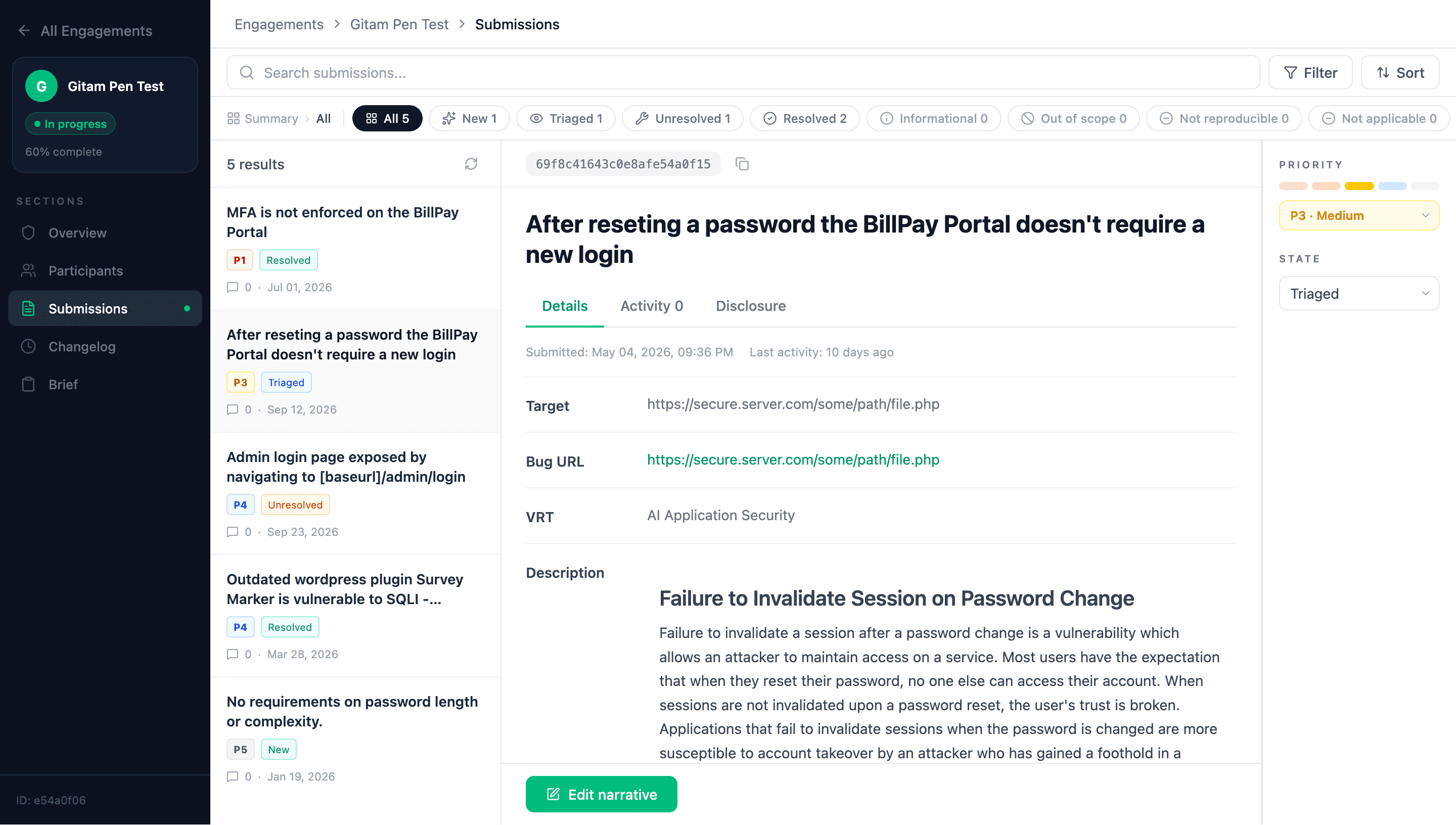
Outcomes our customers see.
Reactive Security Chaos
Continuous Validated Protection
From exposure signals to proven priorities.
Severity scores tell you what could matter. Business context tells you what does. We combine exploitability, blast radius, and your org's risk model into one ordered queue — so the top of the list is the thing to fix next.
Trusted by teams that demand proof.
What we test.
Deep coverage across modern attack surfaces. Every engagement is scoped to your stack and staffed by specialists in the relevant domain.
Web applications
- ›OWASP Top 10
- ›Auth & session flaws
- ›Business logic abuse
- ›SSRF · IDOR · XXE
APIs
- ›REST · GraphQL · gRPC
- ›Auth bypass
- ›Mass assignment
- ›Rate-limit abuse
Mobile apps
- ›iOS · Android
- ›Local data storage
- ›Cert pinning
- ›Reverse engineering
Cloud
- ›AWS · GCP · Azure
- ›IAM misconfigs
- ›Container escapes
- ›Privilege escalation
Infrastructure
- ›External perimeter
- ›Internal networks
- ›Active Directory
- ›Lateral movement
Smart contracts
- ›Solidity audits
- ›Reentrancy
- ›Oracle manipulation
- ›Flash loan vectors
Source code review
- ›Manual SAST
- ›Dependency analysis
- ›Secret hunting
- ›CI/CD pipeline review
Red team & social
- ›Phishing campaigns
- ›Pretexting
- ›Physical recon
- ›Adversary emulation
How it works
A streamlined path from onboarding to remediation.
Scope & connect
Define your assets and integrate via API, CLI, or GitHub.
Automated recon
Our engine maps your attack surface and runs baseline scans.
Manual exploitation
Vetted hackers probe complex business logic and auth flaws.
Patch & validate
Receive PoC + remediation guidance. Click 'Retest' when fixed.
How attackers think. How we cut the chain.
We model each engagement against the full intrusion lifecycle. Every phase has a corresponding probe — and a corresponding countermeasure we validate is in place.
Recon
Map exposed assets, scrape OSINT, fingerprint stack
Initial Access
Phish, exploit public-facing apps, valid creds abuse
Privilege Esc.
Escape role limits, abuse misconfigured IAM
Lateral Move
Pivot through internal network, abuse trust paths
Data Access
Reach crown-jewel data stores, dump artifacts
Exfiltration
Stage and extract data, evade DLP signals
Surface mapping
Continuous discovery, exposed asset inventory, fingerprint diff
Auth & app hardening
Phish-resistance audit, MFA gaps, broken access controls
IAM exploitability
Role chain analysis, over-permissioned identities, escape probes
Internal pentest
Network segmentation tests, AD tiering, trust boundary review
Data-store audit
Encryption at rest, key rotation, query path access proofs
Egress validation
DLP gap testing, anomalous outbound, staging-area probes
Lives where your team works.
Push findings into Jira, alert on critical via Slack, gate releases in GitHub Actions, and export reports to your tooling. Two-way sync, no scripting required.
- Native webhooks + REST API for everything
- SAML/SSO + SCIM provisioning
- Two-way Jira and Linear sync
- GitHub / GitLab status checks on PRs
AGENTS
Prioritize
Act
Security that gates every release — without slowing one.
BugThrive plugs into your CI/CD as a first-class step. Fast scan on every PR, deep scan on release branches, automatic block on critical findings. Engineers stay in their IDE.
1 medium finding detected — auto-routed to owner, merge blocked until acknowledged.
The right model for modern teams.
Side-by-side: PTaaS vs legacy approaches.
Built around your stack.
Three tiers, scoped to your team size and surface area. Every plan is quoted after a 30-min scoping call.
Standard
For growing startups.
- 1 application
- Quarterly deep scans
- Email support
- Unlimited retests
Plus
For shipping-fast teams.
- 3 applications
- Continuous scanning
- Monthly manual exploitation
- Direct Slack channel
- API & Web3 support
Enterprise
For large organizations.
- Unlimited applications
- Dedicated red team
- Custom cloud architecture
- 24/7 phone support
- SSO + SCIM
Every plan includes unlimited retests and 24h triage SLA. Talk to us about scoping →
Built for builders, not buyers.
The 2026 PTaaS buyer's guide
Compare PTaaS, bug bounty, and traditional pentest models.
State of pentesting · Q1 2026
Trends across 280 teams: stack, frequency, cost, MTTR.
Continuous security in CI/CD
Concrete walkthrough of pipeline integration patterns.
Frequently asked
PTaaS is a modern approach to security testing that combines the depth of manual penetration testing with the speed and continuous nature of automated scanning. It gives your team real-time visibility into vulnerabilities as they are discovered.
Bug bounties rely on a crowd of independent researchers finding vulnerabilities in production, whereas PTaaS involves dedicated security experts methodically testing your applications often before they even reach production.
Scope typically includes external network perimeters, web and mobile applications, internal networks, and critical APIs. We work with you to define a tailored scope that prioritizes your most critical business assets.
Our testers go through a rigorous multi-stage vetting process including background checks, practical hacking assessments, and communication evaluations to ensure they meet our quality standards.
Most engagements kick off within 5 business days of scoping. For urgent needs (incident response, pre-launch audits), we offer expedited onboarding with a senior team in 48 hours.
Yes — unlimited re-tests are included on every engagement. Push a fix, click 'Verify', and the original tester confirms remediation within hours, not weeks.
Have a question we haven't covered? Get in touch →
Stop managing vulnerabilities.
Start reducing exposure.
Join hundreds of engineering teams who treat security as a built-in feature, not an annual roadblock.